For a long time, the full investment power of Aliko Dangote, Africa's richest man and the founder of the Dangote Group, has felt like a looming but largely unexplored force in Kenya. His name has come up in boardrooms, policy forums, and business circles for over a decade, yet the scale of ambition he represents has never fully materialised on Kenyan soil.
Until now, that may be about to change.
From an unsuccessful attempt to establish large-scale mining operations in Kitui to the quiet but confident acquisition of shares in Pollman's Tours and Safaris, Dangote's relationship with Kenya has been one of persistent interest, occasionally frustrated, but never fully abandoned. Today, with a declared interest in building a massive oil refinery on Kenya's coast, the story has entered its most consequential chapter yet.
The ball is firmly in Kenya's court.
A History of Interest: The Road to This Moment
To understand the significance of what Dangote is now proposing, it helps to trace the arc of his engagement with Kenya.
In 2013 and again in 2015, Dangote made moves to establish significant mining operations in Kitui County, securing licenses to prospect for limestone in the Kanziku-Simisi area. The vision was ambitious, a large-scale extraction that would feed his cement manufacturing interests across the continent. But the project ran into serious headwinds. Community compensation disputes slowed progress, and stiff competition from well-entrenched local players like ARM Cement and Bamburi made the economics increasingly difficult to justify.
The mining dream faded. For years, it appeared that Dangote's Kenyan chapter had closed before it truly opened.
But beneath the surface, the interest never died. It evolved.
His recent acquisition of a 100% stake in Pollman's Tours and Safaris, Kenya's oldest tour operator, in a deal valued at approximately $31 million (KSh 4 billion) through his private equity firm Alterra Capital, signals something important. This was not a distressed purchase or an opportunistic play. It was a deliberate entry into Kenya's experience economy, a sector that has shown consistent resilience even through global disruptions. It was the move of an investor who has studied the market, recalibrated his approach, and decided Kenya is worth a long term commitment.
The Pollman's acquisition was the quiet opening act. The refinery is the headline.
The $17 Billion Question
Dangote is eyeing a 650,000-barrel-per-day oil refinery, a project estimated to cost between $15 billion and $17 billion, equivalent to approximately KSh 1.9 trillion to KSh 2.2 trillion at current exchange rates. To put that figure in context, it is roughly 1.5 times Kenya's entire national budget for the 2024/2025 financial year.
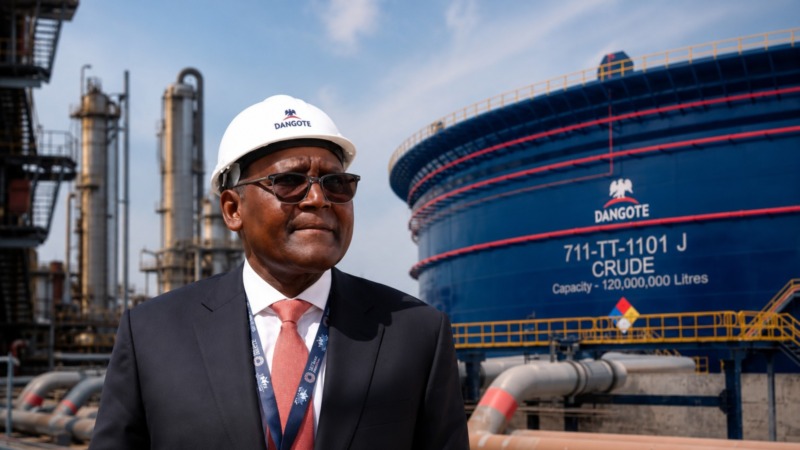
This is not a speculative proposal. Dangote has built and operated at this scale before. His Dangote Refinery in Lekki, Lagos, a $20 billion facility, is the largest single train refinery in the world. When completed at full capacity, it is designed to process 650,000 barrels of crude oil per day, meeting Nigeria's entire fuel demand and producing surplus for export across Africa. He is not imagining what a refinery looks like. He is proposing to replicate a model he has already proven.
The original regional conversation pointed toward Tanga, Tanzania, as a potential location, primarily due to its proximity to the terminus of the East African Crude Oil Pipeline (EACOP), the controversial pipeline that will carry crude from Uganda's Lake Albert oilfields to the Tanzanian coast for export.
But Dangote has since shifted his position publicly, and explicitly he now favours Mombasa.
His reasoning is commercial and straightforward. Mombasa offers a deeper port capable of accommodating the ultra-large crude carriers that a refinery of this scale would require. It also sits within a larger economy with significantly higher fuel consumption, meaning the domestic market alone provides a stronger commercial foundation. And critically, routing crude directly to Mombasa removes the dependency on long pipeline infrastructure from the Ugandan oilfields, a logistical and geopolitical simplification that carries real financial value.
Two Paths in Mombasa: Kipevu or Dongo Kundu?
Should the Kenyan government extend the green light, Dangote faces a fundamental strategic choice between two very different development paths, each with its own set of numbers, risks, and possibilities.
Option One: Reviving the Kipevu Refinery
The former Kenya Petroleum Refineries Limited (KPRL) facility in Changamwe carries significant historical weight. Commissioned in 1960, it supplied refined petroleum products to Kenya and the broader East African region for over five decades before refining operations ceased in 2013. Today, the facility continues to function as a fuel storage and distribution hub, retaining established pipeline connections and a regional logistics role.
The case for Kipevu rests on its existing infrastructure. Unlike a blank site, it comes with pipeline networks, storage tanks, port connections, and a history of operational knowledge in the surrounding community and workforce. Proponents, including Mombasa Senator Mohamed Faki, have argued that upgrading existing domestic infrastructure could be achieved at a lower cost than constructing an entirely new facility.
However, the counterargument is compelling. The Kenyan government has consistently maintained that the facility is no longer commercially viable in its current state, a position rooted in the reality of aging infrastructure, high operational costs, and the complexity of bringing a dormant industrial plant back to competitive performance. Reviving a facility that has been non-operational for over a decade is rarely as straightforward as it appears on paper. Technical overhauls of this nature frequently encounter hidden costs that rival and sometimes exceed the price of new construction.
There is also the question of design limitations. A 60-year-old site layout constrains what is possible. Modern refining technology, efficiency benchmarks, and environmental compliance requirements have advanced enormously since Kipevu was built. Retrofitting old infrastructure to meet those standards is a fundamentally different challenge from designing a facility from scratch to meet them.
Option Two: Building at Dongo Kundu Special Economic Zone
The Dongo Kundu Special Economic Zone represents the alternative and, in many respects, the more forward-looking path.
Located on the southern side of Mombasa, Dongo Kundu is positioned as Kenya's flagship SEZ, designed specifically to attract large-scale industrial and manufacturing investment. The zone is already drawing interest from significant players, including Taifa Gas of Tanzania and a range of Chinese, Korean, and Japanese firms across various sectors.
It is important to be clear about what Dongo Kundu currently is at this stage. It is primarily land and potential. No ready-built structures are waiting for an anchor tenant. An investor choosing this path builds every facility from the ground up. That is a significant capital and time commitment.
But that is also precisely its appeal for an investor of Dangote's ambition and operational philosophy.
Building from scratch at Dongo Kundu would allow Dangote to replicate the Lekki model, a modern, purpose-built, single-train refinery designed around the latest petrochemical and processing technologies. No legacy constraints. No retrofitting compromises. No, 60-year-old site layouts dictate what is possible. Just a clean slate engineered for maximum efficiency and long-term competitiveness.
The SEZ framework also brings government incentives tax structures, regulatory streamlining, and infrastructure support that are specifically designed to make large-scale industrial investment viable. For a project requiring the kind of policy partnership that Dangote has explicitly signalled, including land provision and protection from the dumping of cheap imported fuel, an SEZ environment provides a more structured and predictable framework for those negotiations.
The Policy Conversation Kenya Cannot Avoid
Dangote has been direct about one thing: for this refinery to survive commercially, he will need more than land.
He needs policy protection.
Specifically, he has flagged the risk of cheap fuel imports being dumped into the Kenyan market at prices that an onshore refinery cannot compete with, a pattern that has undermined domestic refining operations in several African markets. Addressing this requires government intervention through tariff structures, import regulations, and a deliberate industrial policy that prioritises domestic refining capacity.
This is the conversation that President William Ruto's administration will have to engage with seriously. It is not a simple ask; Kenya operates within regional trade frameworks and international agreements that constrain unilateral import protection. But it is also not an unreasonable ask from an investor proposing to inject up to $17 billion into the economy and create thousands of jobs.
The policy architecture around this investment will be as consequential as the investment itself.
What This Means for Mombasa and the Coast
The numbers, if this project reaches fruition, are staggering in their local implications.
A 650,000-barrel-per-day facility is not just an industrial installation. It is an economic ecosystem. Construction alone at this scale generates years of employment across engineering, logistics, civil works, security, catering, and support services. Operational employment spans refinery technicians, pipeline operators, port workers, quality control specialists, administrative staff, and management across multiple tiers.
Beyond direct employment, the secondary economic activity generated by a facility of this size, including housing demand, retail, transport, and professional services, reshapes the economy of the surrounding region.
Dangote has also indicated that he is structuring a dedicated investment vehicle in Kenya to allow local investors to participate in the group ahead of a planned IPO, with returns denominated in US dollars. This is a significant detail. It means the wealth generation potential of this project is not reserved exclusively for foreign capital. Kenyans, including coastal residents, will have a pathway to own a piece of what is built here.
Kenya Must Be Ready
Here is the honest reality: an opportunity of this magnitude does not wait indefinitely.
Dangote is a businessman operating on a continental scale. If the policy environment, the land negotiations, and the regulatory conversations in Kenya move too slowly or become too unpredictable, the calculus shifts. Tanzania has not stopped being an option. Other East African port cities are not standing still.
What Kenya and Mombasa specifically must do is demonstrate readiness. Not just political will at the top, but genuine systemic preparation across the full value chain that a project like this demands.
That means accelerating the development of Dongo Kundu's foundational infrastructure. It means beginning the workforce development pipeline now, with technical and vocational training programmes aligned to petrochemical and refinery operations, not starting when the groundbreaking happens, but years before. It means the legal and regulatory frameworks for SEZ investment are clear, consistent, and efficient. And it means the policy protection conversation is being handled with sophistication, balancing Kenya's international trade obligations with the legitimate industrial policy interests of a country trying to move up the value chain.
Dangote has done his part. He has stated his preference.
The next move belongs to Kenya.
And when Africa's richest man finally lands on this coast, the question will not be whether the opportunity was real.
The question will be whether we were ready to rise with it.